

If you’re hiring product design help in 2026, you’ll meet two kinds of agencies. One works the way agencies always have: people, hours, retainers. The other has rebuilt its process around AI. Both can hand you polished screens, so on the surface they look interchangeable.
The difference shows up in three places that matter to you directly: how fast you get to a validated direction, how much it costs to change your mind, and how much the agency can take on without slowing down. This guide honestly breaks down the two models, including their work processes, the red flags to watch for, and a simple checklist to decide which one your team actually needs.
Definitions: what each model actually is
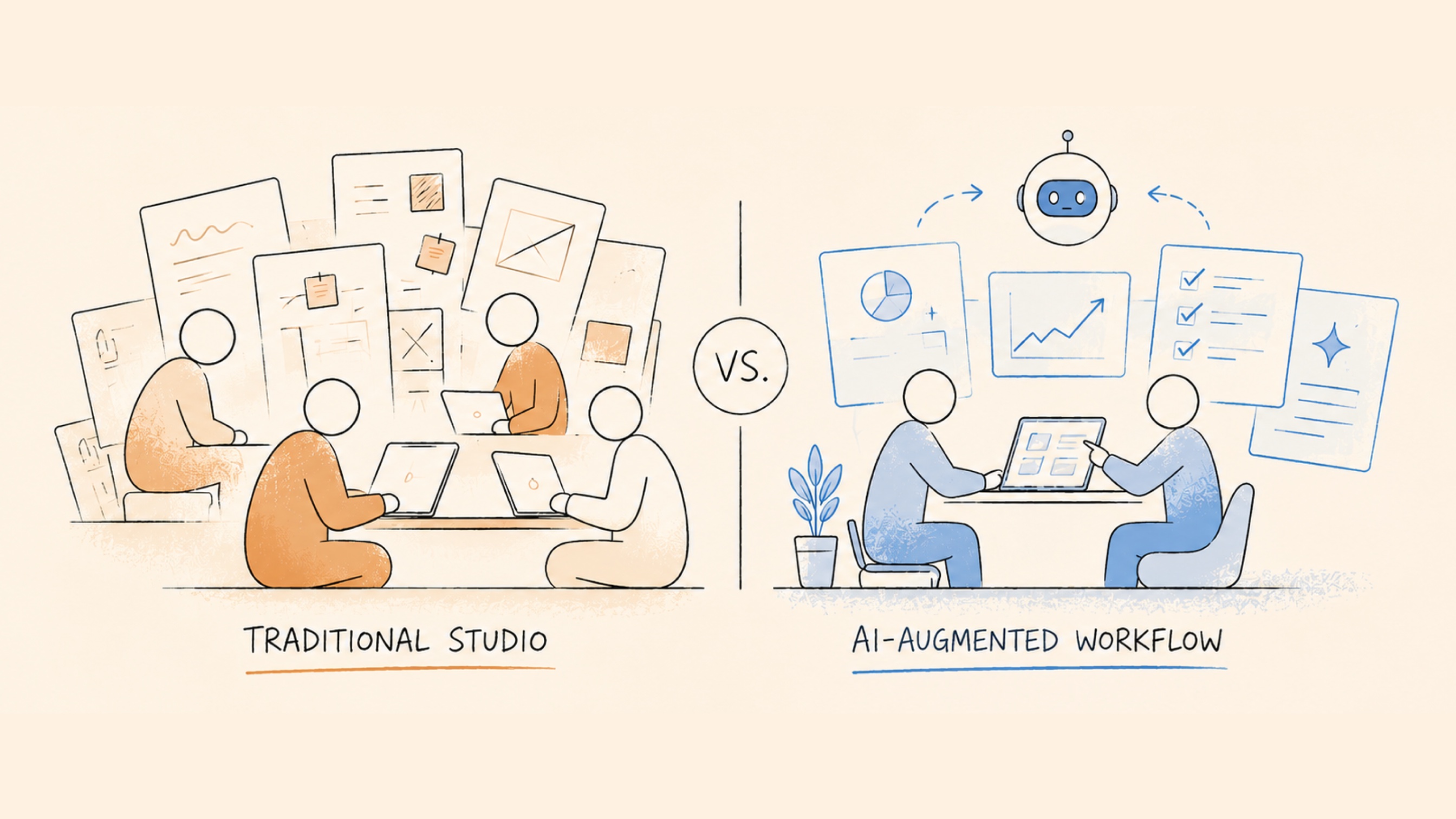
Before hiring an agency, whether traditional or AI-augmented, you need to understand what each entails. So, let’s start with something familiar to you, namely a traditional design agency.
Hiring this agency means hiring a team of designers, usually a mix of senior and junior, who do the work largely by hand. You’re billed by the hour or a monthly retainer. Quality depends on who’s assigned to your project, whereas speed depends on how many people they can put on it. When you need more output, they need more headcount, and that takes time to hire and onboard.
On the other side, there’s a new phenomenon — an AI-augmented design agency. Here, senior designers use AI inside the workflow to remove the slow, repetitive parts of the job: synthesizing research, generating exploration, drafting screens and states, and maintaining design systems. While AI does the heavy lifting, the designers make every decision and own the quality. The result is more output from a smaller, more senior team, without adding people one-for-one. If you are interested in this kind of agency, here’s our article on what an AI-augmented design agency means.
We’ve also compiled a structured comparison of these two types of agencies according to key factors:
| Dimension | Traditional agency | AI-augmented agency |
|---|---|---|
| Time to first concepts | Slower, often after initial discovery and alignment | Faster, with AI speeding up synthesis and early exploration |
| Directions explored before committing | A few | More, narrowed by senior judgment |
| Cost per iteration | High (human hours) | Lower (AI handles production) |
| How capacity scales | Hire more people | Same senior team, more output |
| Where quality is decided | Human | Human |
| Main failure mode | Slow and expensive | Fast mediocrity if AI is unsupervised |
The last row is the one people frequently miss. The AI-augmented model only wins when a senior designer is steering. When pointed at a weak process, AI just generates more average work faster. The key point: AI-augmented doesn’t mean replacing designers. It means experienced designers with leverage. That difference determines whether you get better work faster or just faster, mediocre results.
What 20 screens look like in two models
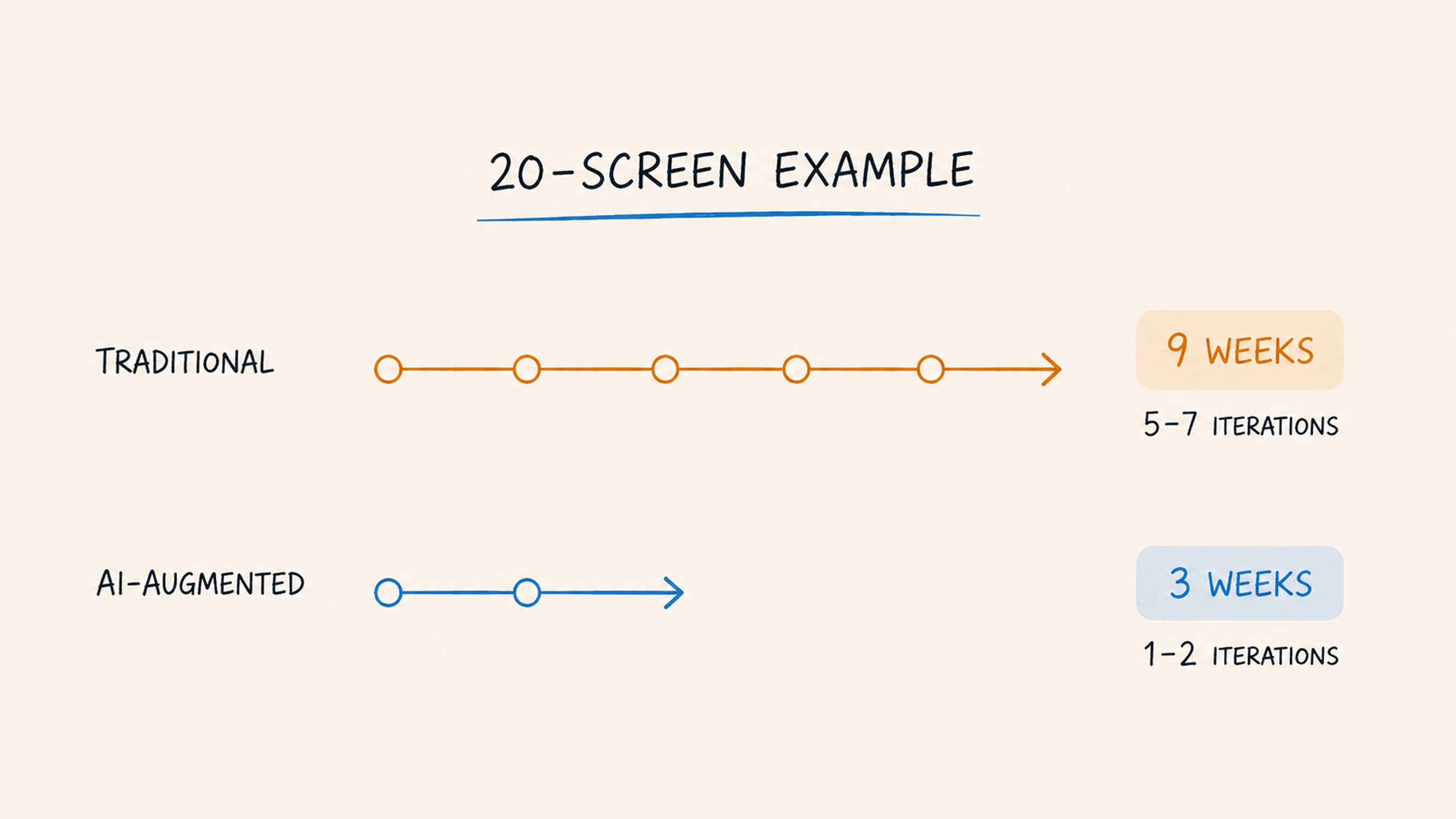
Imagine you need roughly 20 screens for a new feature set, with exploration, prototyping, and a few design-system additions. When you take this request to a traditional or AI-augmented agency, you get two very different approaches.
In the traditional model, the first few days usually go into discovery, research, and alignment. After that, the team explores two or three directions because each one costs the designer hours. You review, pick one, and they produce the screens over the next several weeks. Each significant change means more hours billed, because while adding scope, the team also adds people or extends the timeline.
If you opt for an AI-augmented path, the early research stage still needs designer judgment, but synthesis moves faster. Instead of stretching the analysis phase, AI helps digest inputs, cluster patterns, and surface directions more quickly. Exploration widens too: the team can put more directions in front of you, then kill the weak ones with senior judgment. Besides, repetitive screens and states are produced faster, so high-fidelity work is ready sooner. With lower iteration costs, you can test and pivot more often before engineering begins, when changes are still the most affordable.
Where the AI-augmented model wins
The AI-augmented model performs best in situations where scale, speed, and efficiency all matter at once. When design becomes a bottleneck, it allows you to combine senior-level craft with higher output, all without the time and cost of building a large in-house team. This is especially valuable when you need to move quickly from a loose idea to something concrete enough to discuss, test, and refine.
It also changes how you use your budget. With a lower cost per iteration, you’re not forced to commit early. You can explore more options, test them, and adjust direction without overspending. And when you’re working on a live product, continuously adding features, screens, and expanding the design system, this model is particularly effective. If you are interested in an AI-augmented design agency, check out our process and decide whether it suits your project.
However, not every agency that says it uses AI is truly AI-augmented in the way we describe here. For a closer look at the difference, see our article on how 11 leading design agencies actually use AI in 2026.
Where a traditional agency can still be the right call
The AI-augmented model isn’t one-size-fits-all, and pretending otherwise would be dishonest. A traditional studio can be a better fit in a few specific situations.
If the work is small, one-off, or highly bespoke, then speed matters less than craft and attention to detail. In the case of a single landing page or a brand film, a more traditional approach often makes sense.
It’s also the right choice when you’re hiring for a particular style or reputation. Sometimes you’re paying for a recognizable aesthetic or a well-known designer, and that’s a valid reason to choose a specific studio.
Practical considerations matter, too. Some companies, especially larger ones, have rules that favor familiar, established vendors, even if they’re not the fastest. In the end, choosing an agency isn’t about chasing novelty — it’s about finding a partner who gets your work to the right outcome faster, without sacrificing quality.
How to choose the right partner: red flags and questions to ask
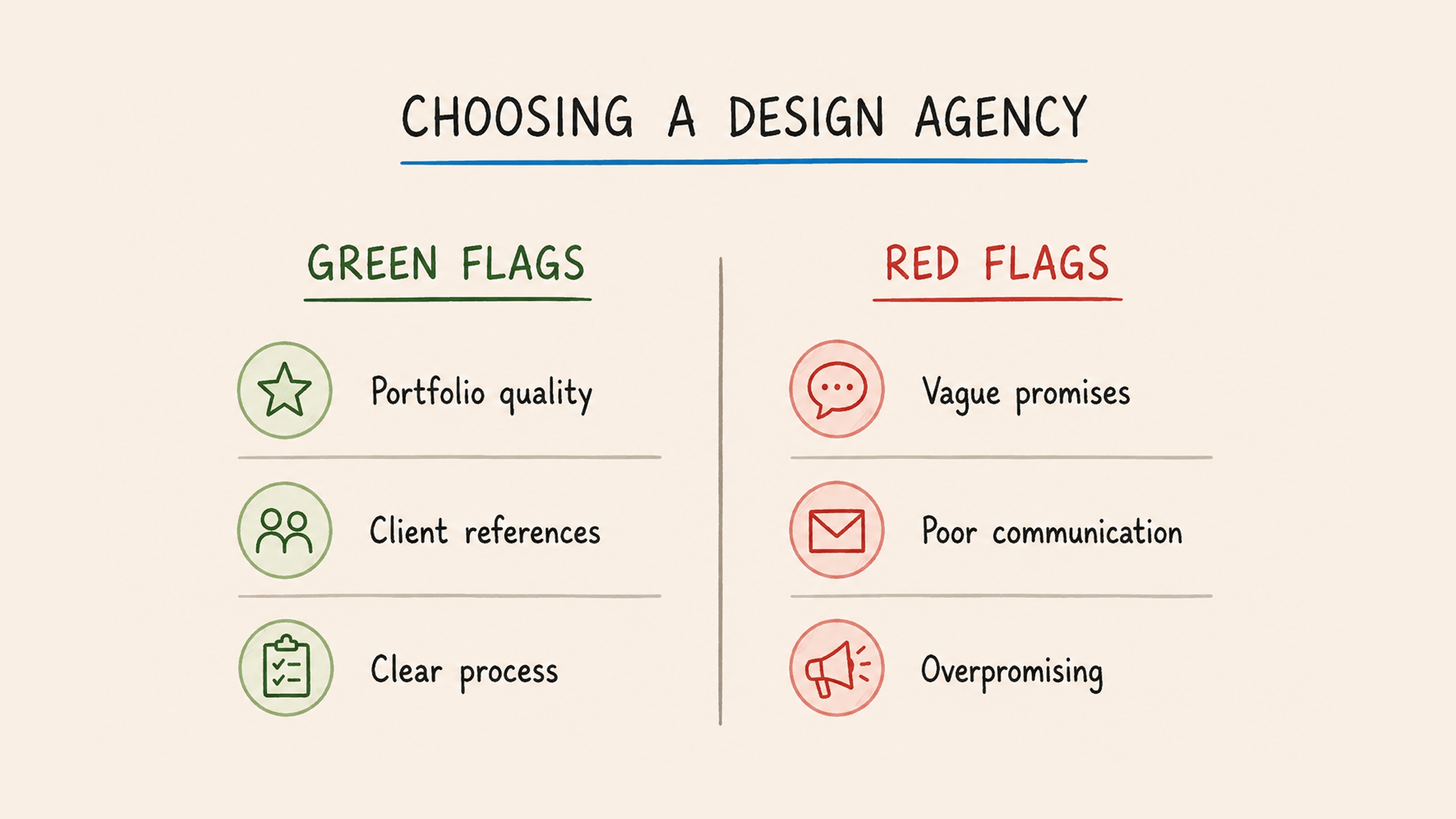
Selecting a design partner can feel overwhelming, especially when every agency claims to do the same thing. The fastest way to cut through the noise is to look beyond polished portfolios and listen closely to how they work. Below, you’ll find the most common red flags to watch for and the key questions that help you separate real partners from good sales pitches.
Red flags at an AI-augmented agency
AI can be powerful, but only when it’s used intentionally. These warning signs usually mean it’s being used as a shortcut, not a strength:
- No explanation of where human judgment lives. If it sounds like AI is making the decisions, expect generic, low-impact work.
- No clear review gate. Every output should be reviewed by a real expert. “The AI handles it” is a red flag.
- “AI” as just a buzzword. If they can’t explain what AI actually does at each stage or what you gain from it, it’s likely surface-level.
- Promise of speed without mentioning quality control. Fast is meaningless if it creates more rework later.
Red flags at a traditional agency
If you want to choose a traditional agency, there is one thing you must keep in mind: experience still matters, but outdated processes can slow you down. Therefore, watch for signs that an agency hasn’t adapted:
- No clear justification for their pace or price. If they can’t explain why things take as long (or cost as much) as they do today, that’s a concern.
- Senior talent sells, junior talent delivers. If the experts disappear after the pitch, you’re not getting what you signed up for.
- Too many layers between you and the work. Long feedback chains and account managers can dilute clarity and slow decisions.
- Work is shown too late. Big reveals near the end leave little room for affordable changes. Good partners share early and often.
How to quickly spot the right agency
Once you know what to avoid, the next step is simple: ask better questions. These five will quickly reveal how an agency really operates, whether it’s traditional or AI-augmented.
- What does AI do in your process, and what stays human? You want a clear split: AI on production, humans on decisions.
- Who reviews and approves the output before it ships? A senior expert should stand behind every deliverable.
- What do I actually get from your model? Faster cycles, more exploration, lower cost per iteration — a good agency has to name it.
- Can you show results, not just screens? It includes cycle time, iteration count, design-system coverage, or real business outcomes.
- Who exactly works on my project? The people in the pitch should be the people doing the work.
To specify, if an “AI-augmented” agency struggles to answer the first and the second questions, it’s likely selling a buzzword. If a traditional agency can’t clearly answer the third question, it hasn’t kept up.
The honest bottom line
For a one-off, deeply bespoke piece of craft, a traditional studio can still be perfect. For a scaling product team where design is the bottleneck and the roadmap won’t wait, the AI-augmented model usually wins. It combines senior judgment with far more exploration and iteration per dollar, delivering the output of a larger team without the overhead. What you must do is just make sure a human is unmistakably in charge. That single factor separates the model that produces better work faster from the one that produces more average work faster.
FAQ
How do an AI-augmented and a traditional design agency differ?
A traditional agency does the work by hand and bills by the hour, scaling capacity by hiring. An AI-augmented agency uses AI for the heavy lifting while senior designers make every decision, delivering more output, faster, at a lower cost per iteration.
Is an AI-augmented agency cheaper?
Total cost depends on scope, but cost per iteration is typically lower, so you get the volume of a larger team without the overhead.
Is the quality lower when AI is involved?
Not when senior designers steer it. AI widens exploration and speeds iteration, so the final work tends to be more considered, not less. The risk is “AI on autopilot,” which is why a human review gate is necessary.
Is an AI-augmented agency just using ChatGPT and Midjourney?
Tools are part of it, but the model is about process, not a specific app. A real AI-augmented agency has rebuilt how research, exploration, prototyping, and systems work, with senior designers owning the output.
Will an AI-augmented agency replace my in-house designers?
No. It’s usually a way to add senior capacity without growing headcount, often working alongside an internal team to clear a backlog or scale delivery.
Which model should a scaling B2B team choose?
If design has become your bottleneck and your roadmap is moving fast, the AI-augmented model typically gives you more senior output without adding people. For occasional, highly bespoke work, a traditional studio may be a better fit.
How do I verify an agency’s AI claims?
Ask for the split between AI and human work, the review process, and concrete results (cycle time, iterations, outcomes). Vague answers are the signal that those claims are mere claims.