

Every design agency now claims to “use AI.” Almost none explain what that means. So we reviewed the public positioning, services, and case studies of 11 of the most visible design agencies in the AI space to understand how they actually use it. And one pattern stood out right away.
What’s interesting is that almost none of the analyzed agencies position the use of AI as their core offering. That gap stands out, and it hints at where the industry is heading, as well as how to interpret any agency’s claims about AI. This article shows that “AI design agencies” fall into two distinct types and explains how confusion between them obscures real value and misleads buyers.
The two kinds of “AI design agency”
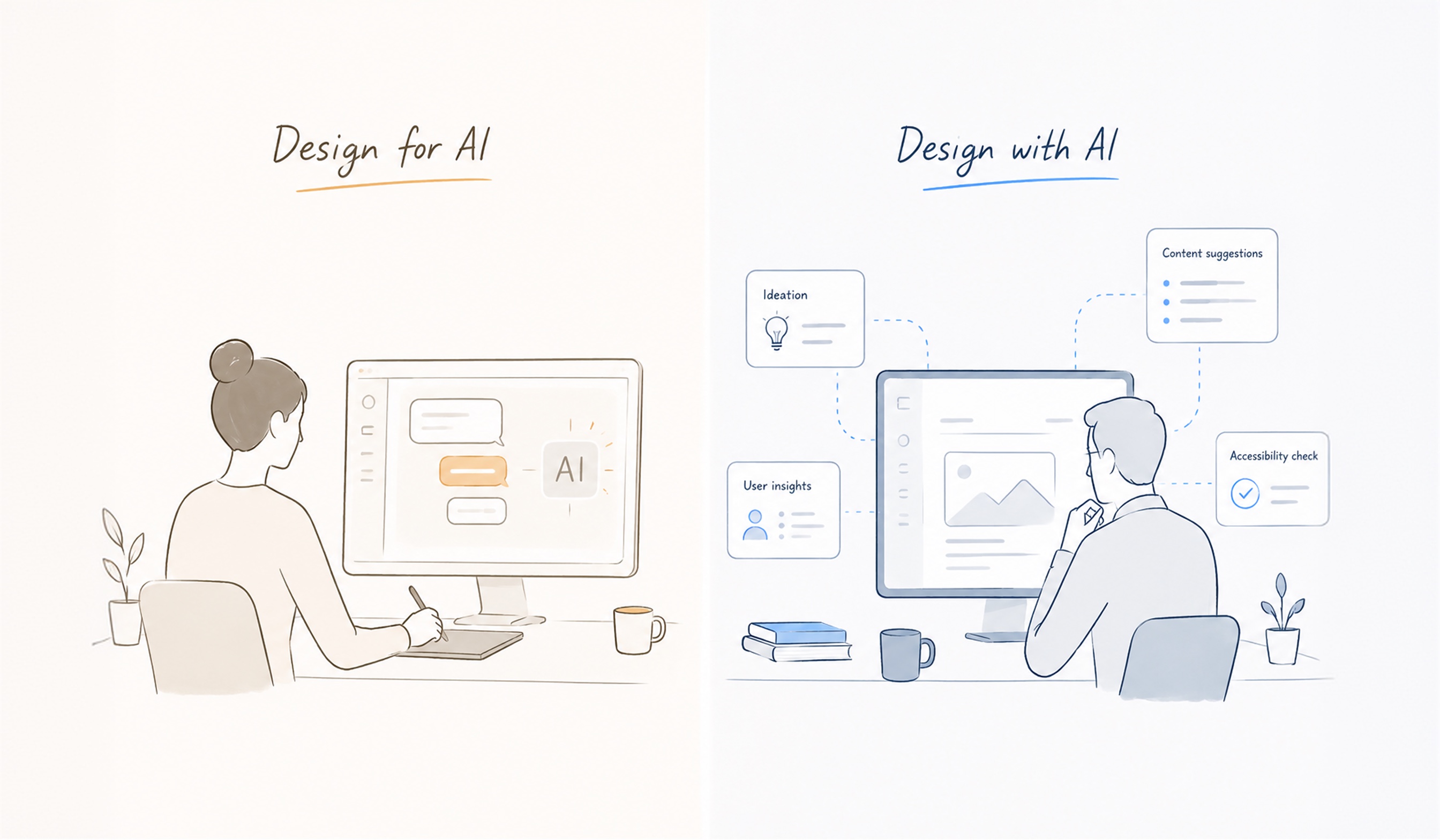
“AI design agency” can mean two completely different things. Some agencies design AI products. Others design with AI, using it within their own processes to ship faster and more cheaply. To put it simply:
- Design for AI. The agency’s output is an AI product: chat interfaces, agentic workflows, model dashboards, or AI-native UX. The AI is built into what the agency delivers — more like a specialized product or engineering team.
- Design with AI. The agency’s process is AI-augmented. Senior designers use AI for research synthesis, exploration, prototyping, and design systems to provide ordinary product design faster and at lower cost. The AI lives in how they work, not necessarily in what you get, as you can find out in our article Will AI replace UX designers?
These are different businesses with different buyers. Mixing these up is the main cause of confusion in this space and the strongest opening for an agency ready to commit to a clear direction.
For customers, understanding which lane an agency operates in helps them avoid costly mismatches, like hiring an AI product specialist for a simple dashboard redesign or expecting a process-driven studio to build a custom model.
How top agencies are using AI in practice
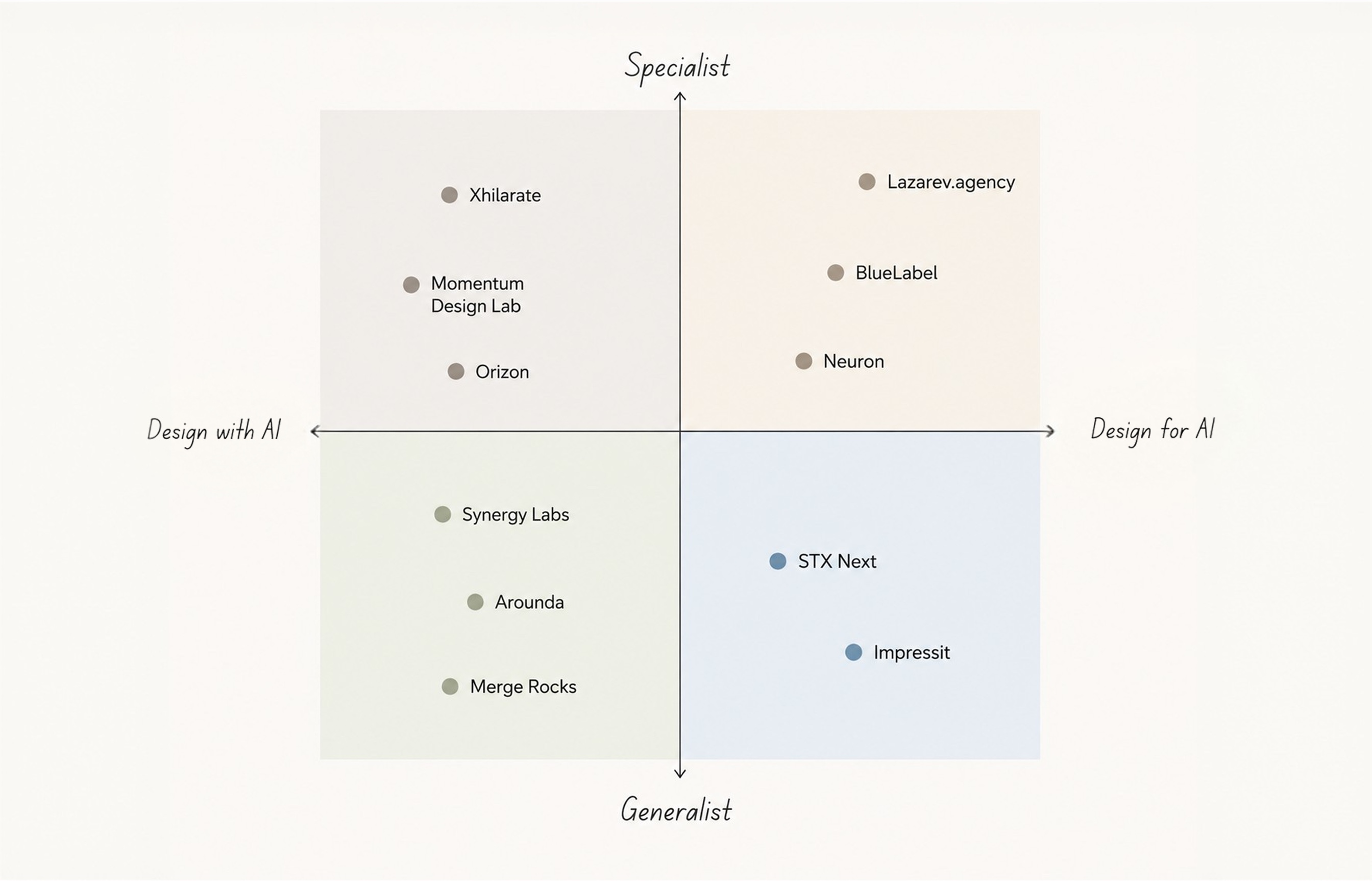
We grouped each agency based on how it primarily presents itself publicly — by examining how it describes its services, positioning, and case studies. Some clearly lean toward one lane, while others straddle both. In those cases, we’ve indicated the stronger leaning.
Here’s how they break down:
- Lazarev.agency (Design for AI). A product design agency focused on AI-native B2B tools, with experience dating back to 2017. Here, AI is embedded directly in the products they create.
- Momentum Design Lab (Both, leaning process). An enterprise design firm with engineering roots, promoting a “Cognitive Design” approach. It comes closest to highlighting AI as part of its process, though that idea isn’t front and center.
- STX Next (Design for AI, build). An AI-first technology partner built around Python, offering AI, data, and cloud engineering. Design supports the core focus: building AI-driven products and infrastructure.
- BlueLabel (Design for AI). Positions itself as a partner for building agentic AI products, with structured sprint programs and a focus on strategy through to delivery.
- Synergy Labs (Design with AI, light). A mobile app agency that adds AI features through its “AI Infusion Service,” with a strong emphasis on speed and practical execution.
- Impressit (Design for AI, build). A secure AI development partner offering rapid discovery phases and custom AI solutions, backed by dedicated teams.
- Arounda (Design with AI, light). A design and development studio working across SaaS, Web3, and AI. It experiments with AI but doesn’t position it as a core offering.
- Xhilarate (Design with AI, creative). A branding-focused studio that uses generative AI for creative exploration and visual production.
- Neuron (Design for AI, enterprise). A boutique UX agency specializing in enterprise products, including AI interfaces and productivity tools for B2B teams.
- Orizon (Both, generalist). A generalist UX/UI studio offering a wide range of services, including AI, LLMs, and spatial computing, though AI is just one of many capabilities.
- Merge Rocks (Design with AI, light). A startup-focused UX studio for B2B, SaaS, and fintech, offering AI integration as part of a broader, speed-driven design approach.
Key trends across AI design agencies
Looking across all 11 agencies, clear patterns start to emerge in how “AI design” is interpreted in practice. Although the positioning varies, most agencies cluster around a few consistent directions:
- The market is broadly split. Some agencies focus on designing and building AI products, while others use AI inside their own workflows, often as an added capability rather than the center of their positioning.
- AI-augmented process remains largely unclaimed. Very few agencies clearly position the way they work with AI as their main differentiator. Momentum Design Lab comes closest, but even there, the process itself is not the primary narrative.
- “AI” is loud but loosely defined. Most agencies reference AI frequently, but few explain what it actually changes in their process or what clients receive in concrete terms.
- Speed is the dominant promise, but rarely tied to AI explicitly. Many agencies emphasize faster delivery, yet without showing how AI enables that speed, the claim often remains abstract rather than grounded in a clear working model.
When you map agencies by how they use and position AI, most fall into established lanes, while one promising space remains open:
| Lane | Agencies | Positioning maturity |
|---|---|---|
| Design for AI | Lazarev, STX Next, BlueLabel, Impressit, Neuron | Clear, crowded |
| Design with AI | Synergy, Arounda, Xhilarate, Merge | Lightly claimed |
| Both / blurred | Momentum, Orizon | Broad / less defined |
| AI-augmented process as the core positioning | — | Open |
While most agencies compete on what they build, very few clearly differentiate through how they work. That’s the lane Ailume is built to own: an AI-augmented design process, led by senior designers, designed for speed, clarity, and scale in B2B product teams. If that’s the approach you’re looking for, explore how we work.
The real cost of unclear AI positioning
When agencies blur the lines in their AI usage, it becomes easy to choose the wrong partner for the job. For buyers, such a choice usually leads to three expensive outcomes.
First is hiring the wrong lane. In essence, you bring in an AI-product specialist to add features to your live SaaS, and pay for capabilities you don’t need, or hire a generalist for a custom-model build they can’t really do.
You can also end up buying a slogan. “AI-powered” often sounds compelling, but with no explanation of the workflow, this turns out to be a traditional process with a new label and none of the speed or cost benefit.
Finally, unclear AI positioning leads to no way to compare. When every agency says “AI,” but none explains or quantifies it, you can’t tell them apart. As a result, decisions default to brand, price, or gut feel instead of actual fit. The fix is to make agencies be specific, which is what the questions below are for.
Why the gap matters: the rise of AI-augmented design
For most companies, the urgent question is, “How do we get senior product design faster and cheaper as we scale?” That’s a process question, and it’s exactly what an AI-augmented agency answers: senior designers working with AI, delivering the output of a much larger team without the extra overhead.
Today, using “AI” regarding any product is a fad. However, treating it as just a fad gives no information to the buyer, and they continue selecting agencies based on the price, design, feedback, etc. The real opportunity is to make the AI-augmented process legible: what AI does, what stays human, and what clients gain in speed, cost, or iteration depth. The lane is wide open precisely because saying “AI” is easy and showing the process is hard.
To understand whether this model fits your needs, read our article on AI-augmented vs. traditional design agency.
What real AI positioning looks like in practice
Clients want to know the approach to using AI. Thus, a credible AI-augmented agency should be able to explain it in simple, concrete terms. At minimum, that means being clear about:
- Process. Answering the question, “Where does AI fit at each stage and stop?” before it’s asked, and where it stops. For example, AI may support research and production, but key decisions still stay with humans.
- Ownership. Clearly explaining who’s accountable, like a senior designer who should review and approve everything before it goes out.
- Outcomes. Stating explicitly what the client actually gets: more directions explored, faster validation, lower cost per iteration, or consistent design systems.
- Evidence. Demonstrating improvements in cycle time or output quality. Real numbers and results work better than just claims.
In practice, you can check whether your partner’s or your AI positioning is valid by asking the following questions:
- “Which lane is the team in: design for AI or with AI?”
- “What does AI actually do in the workflow, and what stays human?”
- “What do clients get from it, and are there measurable results?”
- “Is the work reviewed, or shipped unedited?”
- “Can the agency show improvements in cycle time and cost?”
If those answers aren’t there, the AI isn’t doing much for either an agency or its clients.
The future of AI positioning is clarity
Right now, “AI” is easy to claim and hard to prove. That’s why most agencies stop at the label. But as buyers become more informed, vague positioning will no longer work. Today and in the future, agencies will need to explain AI usage clearly: where it fits, what stays human, and what outcomes improve, with evidence to back it up. In a market where everyone says “AI,” the real divide will shift from what agencies do to how well they can show it.
FAQ
What is an AI-augmented design agency?
A studio where senior designers use AI inside their workflow (research synthesis, exploration, prototyping, design systems) to deliver faster and at lower cost. AI augments the designers; it doesn’t replace them.
Is “AI design agency” the same as “AI-augmented agency?”
Not necessarily. “AI design agency” is used loosely across the market, often referring either to building AI products or using AI internally. Agencies should be explicit about which lane they operate in to avoid blurred positioning.
How can an agency demonstrate that AI is truly part of its process?
By clearly articulating where AI is used across the workflow, how outputs are evaluated, and what measurable impact it has on delivery (speed, cost, iteration depth).
Does AI-augmented design mean lower quality?
No, when senior designers steer it. AI broadens options and accelerates iteration; a human still makes every creative call.
Who needs an AI-augmented design agency?
Scaling B2B teams where design has become the bottleneck and adding headcount isn’t the answer.
How should an agency decide which “AI lane” to commit to?
It depends on its core strength. Agencies focused on product development may lean into designing AI products, while design-led teams can differentiate by owning the AI-augmented process. Trying to do both without clarity often leads to weak positioning.